

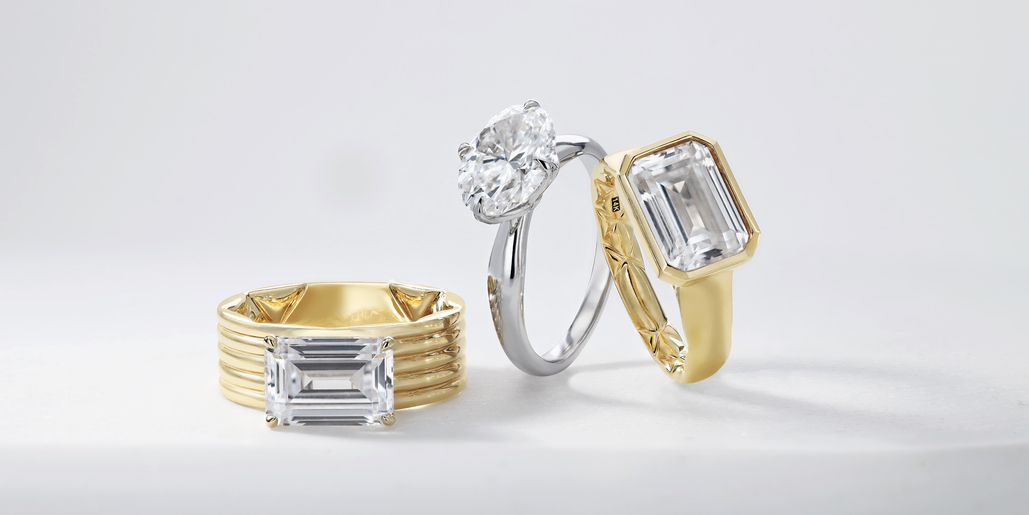
Style icons like Zendaya and Miley Cyrus have brought east-west engagement rings to the mainstream, and more people are now choosing it as a creative way to honor their commitment, proving that sometimes the best way to move forward is to turn tradition on its side. From discovering the most flattering diamond shapes to pairing the perfect wedding band, here’s your complete guide to the east-west style.
What Is an East-West Engagement Ring?
An east west engagement ring features a center stone set horizontally across the band instead of the traditional vertical (north-south) orientation. This left–to–right, east–to–west setting creates a modern silhouette that sets it apart from classic engagement ring styles.
East-West Engagement Ring Meaning
An east-west engagement ring isn’t just a style choice; it carries meaning that reflects the values, personality and unique story of the person wearing it. Here’s what it may represent for those who choose it:
An east-west setting symbolizes the courage to define love on your own terms. Couples who choose this style value individuality, equality and authenticity over following tradition for tradition’s sake.
There’s also a sense of balance and partnership in the design. The stone stretches evenly across the finger rather than pointing in one direction, which many people interpret as a visual metaphor for two lives moving forward together, side by side, rather than one leading the other.
From a broader perspective, the east–west orientation evokes ideas of connection and continuity. East and west are opposites, yet part of the same horizon, symbolizing unity, harmony and the idea that different paths or backgrounds can meet beautifully in the middle. For many, it represents a love that spans distance, cultures or perspectives.
Finally, the setting reflects a modern mindset. Choosing an east–west engagement ring signals confidence, creativity and a forward-thinking approach to love. It’s a way of saying, “Our love is timeless, but our story is uniquely ours.”
Not every diamond shape is a candidate for the east-west engagement ring trend. Since round and square (princess) cuts look the same from every angle, they don’t quite capture the “sideways” magic. Instead, look for elongated cuts:
East-West Oval Engagement Ring
Ovals are a natural fit for the east-west setting. Turning the stone sideways emphasizes its soft curves and makes the center stone feel wider and more impactful, while still maintaining the elegance oval diamonds are known for.
East-West Emerald Cut Engagement Ring
An emerald cut feels right at home in an east-west setting. This layout emphasizes the stone’s long, parallel lines and “hall-of-mirrors” facets, drawing the eye across the hand and letting those reflective lines shine in a fresh, unexpected direction.
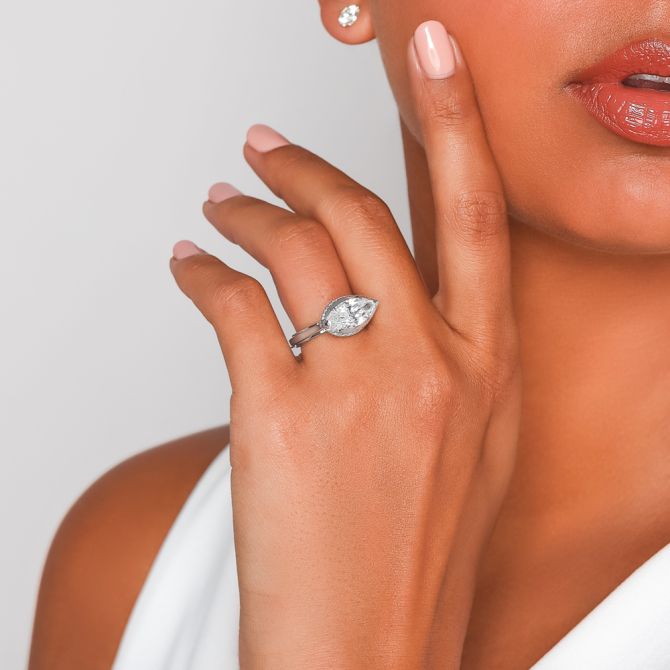
East-West Marquise Engagement Ring
A marquise cut set east-west completely sheds its vintage reputation, telling a whole new story. The pointed ends stretch beautifully across the finger and stay better protected, as the sideways orientation reduces the chance of snagging or bumping the tips.
East-West Radiant Engagement Ring
The radiant cut is already brilliant, but turned east-west, it becomes something special. This placement spreads the stone’s facets across a wider surface, so more of the diamond catches light from different angles throughout the day, making the sparkle feel livelier and more consistent.
East-West Pear Engagement Ring
Set sideways, a pear-shaped diamond transforms from a delicate teardrop into a striking arrow. Depending on which way you point the tip (left or right), you can completely change the perspective and profile of the ring. That little asymmetry adds character and opens up endless possibilities for a unique wedding band stack.
A stone turned across the finger can completely change the look of a ring, so it’s helpful to know what to watch for before buying.
- While vertical stones elongate the finger, horizontal stones can make the finger look slightly wider. If you have shorter fingers, try a thinner band to maintain a balanced look.
- In shapes like ovals and marquises, a dark shadow (the bow-tie) can sometimes appear in the center. When set horizontally, this shadow might be more noticeable, so it’s extra important to view the stone in person or through high-quality photo/video.
- Rotating a diamond along the finger completely reconfigures its light-play. Some areas may sparkle more, others less, so it’s worth asking for high-quality visuals or seeing it in person to make sure the sparkle is balanced and vibrant from all angles.
What Wedding Band Goes Well with an East-West Engagement Ring?
Choosing a wedding band for an east–west engagement ring looks a little different than pairing one with a classic vertical style. The unique layout changes how the rings sit together, which is why the right band matters. Here’s what to consider when finding a band that complements your ring.
Contoured or Curved Wedding Bands
The best choice for most east-west engagement rings is a contoured or curved band. Because the engagement ring sits differently on the finger, a straight band can sometimes leave a gap where it meets the center setting. A contoured band is shaped to hug the base of your engagement ring so everything sits flush and comfortable.
Open Wedding Bands
An open band features a small space in the middle of the ring which allows the east-west stone to sit nestled inside the gap without the bands touching.
Traditional Wedding Bands
If your east-west stone sits high enough in a high-profile setting, a simple gold or platinum band can slide right underneath it. Just be mindful of the diamond making contact with the metal, as this can cause scratching over time.
The east-west engagement ring trend proves that the most stunning designs happen when you aren’t afraid to flip the script. Let your ring be the one that points in a fresh direction.