

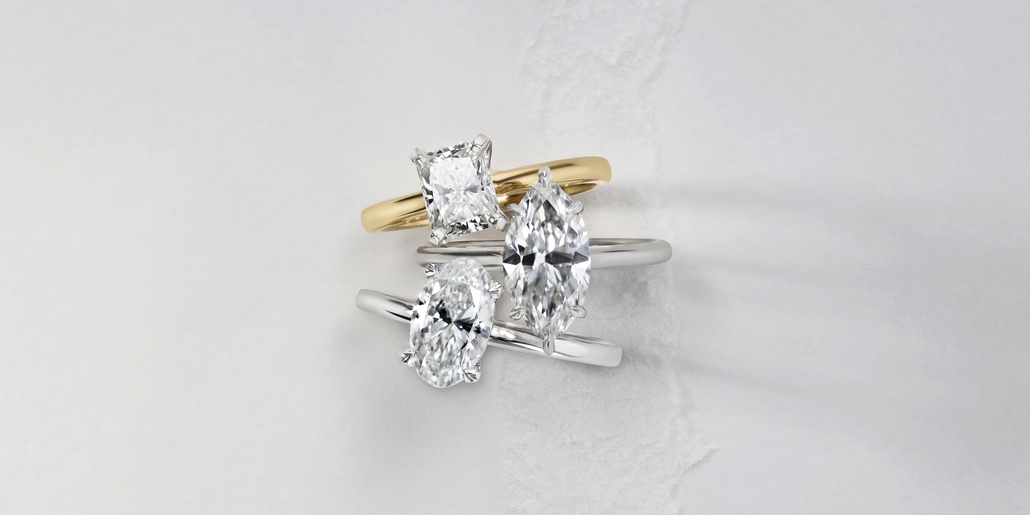
When you envision your dream diamond, you likely imagine a stone that captures light from every angle, radiating brilliance and fire. However, for certain popular diamond shapes, a hidden shadow can sometimes get in the way of that perfect sparkle.
In this guide, we’ll explain what the bowtie effect is, why it happens, how it affects appearance and value and most importantly, how to avoid it when shopping for diamonds.
What Is the Bowtie Effect in Diamonds?
The bowtie effect is a dark shadow that appears across the middle of certain faceted diamonds, most commonly oval, marquise, pear and occasionally heart shapes. When you look at the diamond from the top, that shadow resembles the shape of a bowtie, which is exactly how it got its name.
Visually, it looks like two triangular dark regions that meet in the center and stretch across the width of the stone. Depending on the cut and lighting, the bowtie can be subtle and barely noticeable or more pronounced and hard to miss.
Why Does the Bowtie Happen?
To understand the bowtie effect, it helps to recognize how light travels through a diamond.
A well-cut diamond captures light entering through the top (the table), reflects it off the internal facets and bounces it back to your eye as brilliance. However, if the facets are misaligned or poorly proportioned, light “leaks” out the bottom or sides of the stone instead of returning to the surface.
In fancy shapes (those other than round), the faceting patterns are more complex and vary greatly. Certain configurations naturally encourage uneven light return. The bowtie emerges specifically when light is lost through these central facets, creating a distinctive “dead zone” of shadow where the viewer expects to see sparkle.
Which Diamond Shapes Are Most Prone to Bowties?
Because of their elongated facets, certain fancy cuts are more likely to show a bowtie. Here is the risk level by shape:
- Marquise / Oval / Pear: High
- Radiant / Heart: Moderate
- Cushion / Princess: Low
- Round / Emerald / Asscher: None
How Bowties Affect Diamond Appearance
It’s important to note:
- A slight bowtie is normal in many fancy shapes and not inherently bad.
- A heavy, dark bowtie, however, can noticeably dull the diamond’s sparkle and make it appear lifeless from certain angles.
The effect is especially visible in natural daylight or strong lighting conditions—exactly the environments where you want your diamond to shine.
Here’s how bowties can differ:
Minimal Bowtie
- Light and color return appear even across the shape.
- Dark area is faint and not distracting.
- Sparkle remains vibrant from multiple angles.
Obvious Bowtie
- Dark zones dominate the center.
- Diamond appears “dead” in certain lighting.
- Sparkle is reduced and uneven.
Our ring experts can help you identify these details and weigh the pros and cons. If you’re purchasing online, it’s a good idea to ask for real–life images of the diamond. Many modern tools now allow for a display of the diamond from multiple viewing angles. Since a bowtie won’t appear on a grading report, seeing the diamond in motion is the only way to verify its sparkle.
How to Avoid a Diamond Bowtie
If you’re shopping for a fancy-shaped diamond and want to avoid a noticeable bowtie, here’s what to focus on:
- Check the proportions: Every fancy shape has ideal measurements (length-to-width ratios, table sizeandcrownandpavilionangles) that helpoptimizelight performance.Our ringexpertscan guide you through what these numbers mean.
- Ask for multiple angles and videos: Static photos can be misleading. Request rotating video under consistent light, plus images from the top, side and angled views. Movement reveals how light behaves throughout the diamond.
- See it in person when possible: There’s no substitute for seeing a diamond with your own eyes. In-person viewing lets you see how the bowtie responds to real lighting.
- Work with a trusted jeweler: At Borsheims, we’re completely transparent about our diamonds. We’ll help you understand their qualities and guide you to the diamond that shines just the way you want.