

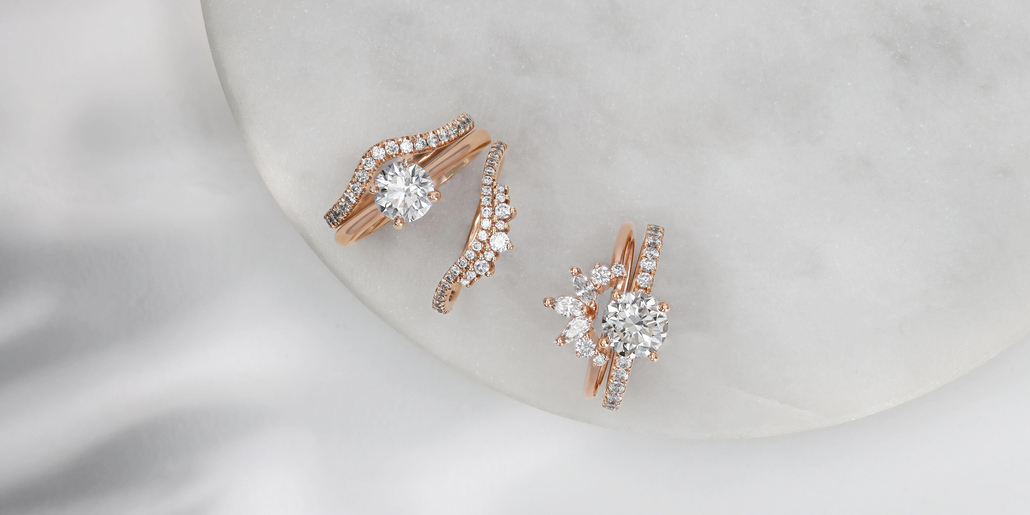
When it comes to choosing a wedding band, many envision a simple, classic ring. But for brides with uniquely shaped engagement rings, especially those with large center stones, halos or unconventional settings, a straight band doesn’t always sit perfectly flush. That’s where curved and contoured wedding bands shine.
Keep reading to learn what curved and contoured wedding bands are, how they’re designed to complement unique engagement ring settings and whether this style is the right fit for your ring and your lifestyle.
What Is a Curved or Contoured Wedding Band?
While the terms are often used interchangeably, they both refer to a band designed with a deliberate arc or dip. Unlike a traditional straight band, these rings are engineered to “hug” the center stone or setting of your engagement ring.
Many engagement rings, especially low-set solitaires, halos or elongated cuts like pears and marquises, don’t allow a straight band to sit flush. This creates a “gap” that some find distracting. A curved band follows the silhouette of the engagement ring, creating a seamless, unified look that feels like a single, intentional piece of jewelry.
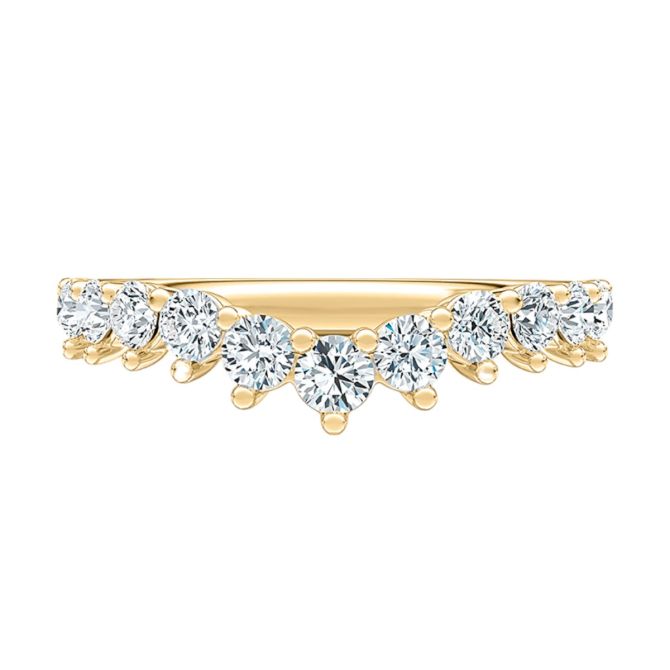
Notched wedding bands are another design solution that feature a small indentation to accommodate a unique setting. Unlike a curved band, which sweeps in a continuous arc, a notched band remains predominantly straight but features a precise cutout in the metal.
Custom vs Pre-Designed Curved Wedding Bands
Custom Curved Wedding Band
Perfect for uniquely shaped engagement rings, our team can create a custom band that fits your ring flawlessly. Discover our custom jewelry design services to begin.
Pre-Designed Curved Wedding Band
We offer a selection of pre-contoured styles designed to accommodate popular ring settings.
Why Choose a Curved Band?
- The gap-free design: If you love everything perfectly aligned, the flush fit is hard to beat. A contoured band eliminates the space between your rings, making the stack look fuller and more “meant-to-be.”
- Protecting your setting: Straight bands can sometimes rub against the prongs or the “basket” of a low-set engagement ring, leading to metal wear over time. A curved band is shaped to avoid this contact, potentially saving you on future jewelry repairs.
- Highlighting unique shapes: If you have a Toi et Moi ring or a modern East-West setting, a straight band can look disconnected. A custom contour celebrates the unique geometry of your engagement ring rather than fighting against it.
Are Curved Wedding Bands Just a Trend?
While modern stacks are trending, curved bands are anything but temporary. They serve a timeless, practical purpose: solving the physical gap created by low-set or uniquely shaped engagement rings. We’ve long offered shaped bands to accommodate evolving engagement ring styles. Their renewed popularity simply reflects how diverse today’s designs have become, requiring a wedding band that’s just as intentional and well-fitted as the center stone itself.
How to Wear a Curved Wedding Band
The most common way to wear a curved band is closest to your heart. This creates a grounded foundation, with the curve cradling the bottom of your engagement ring’s center stone and pointing upward toward your fingernail. Since wedding bands are traditionally placed first during the ceremony, this approach keeps with custom while providing a nested, secure fit.
Some brides prefer to wear the curved band above the engagement ring. This is especially popular with chevron or pear-shaped sets, as it frames the top of the diamond, drawing the eye upward and making the center stone appear larger.
Two identical curved bands—above and below the engagement ring—offer perfect symmetry and are a thoughtful way to celebrate a milestone anniversary or upgrade your set without replacing your original diamond.
Can You Wear a Curved Band Alone?
Absolutely. That said, because of the band’s dip, wearing a curved band solo can create an asymmetrical look on your finger. Many find this “wave” effect artistic and modern. However, if you plan to wear your wedding band alone, you might prefer a chevron style. Its defined “V” shape looks complete and intentional, even without an engagement ring alongside it.
When to Solder Your Wedding Band and Engagement Ring
Most curved bands are asymmetrical. If your band features a distinct “dip,” ensure it’s centered with your ring every time you put it on.
Because a curved band is designed to fit like a puzzle piece, it only looks right when it’s perfectly aligned. For this reason, many brides choose to have their engagement ring and wedding band soldered together into one solid unit.
- Pro: No more constant adjusting or metal-on-metal friction.
- Con: You won’t be able to wear the wedding band on its own without the engagement ring.
Curved and contoured wedding bands are all about creating harmony between two rings that are meant to be worn together for a lifetime. Discover the wedding band that perfectly completes your ring set.