

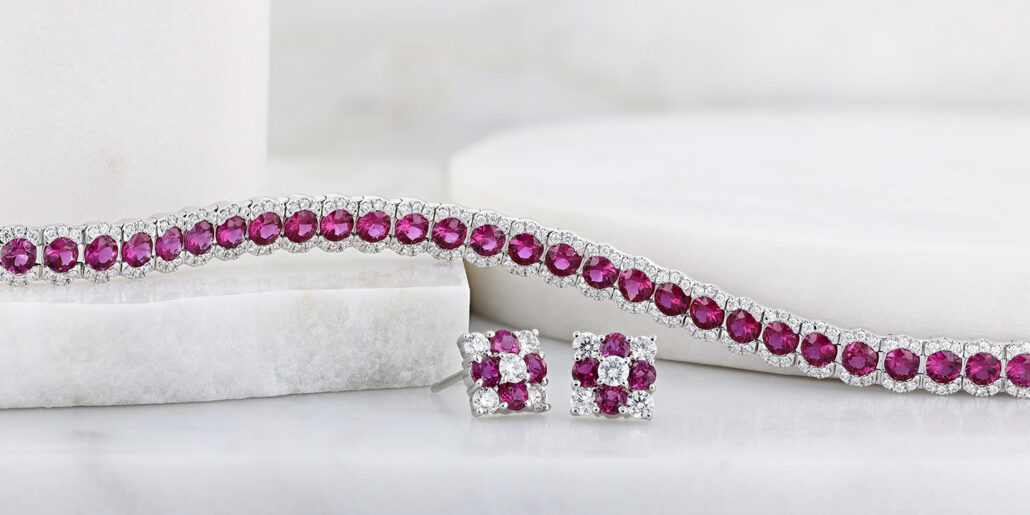
July Birthstone Quick Facts
Ruby Color: Ranges from purple-red to true red to orange-red
Ruby Mohs Hardness Scale Rating: 9
Ruby Symbolism & Meaning: Passion and prosperity
Ruby Zodiac Signs: Cancer and Leo
Other Recognitions: Traditional gift for the 40th wedding anniversary
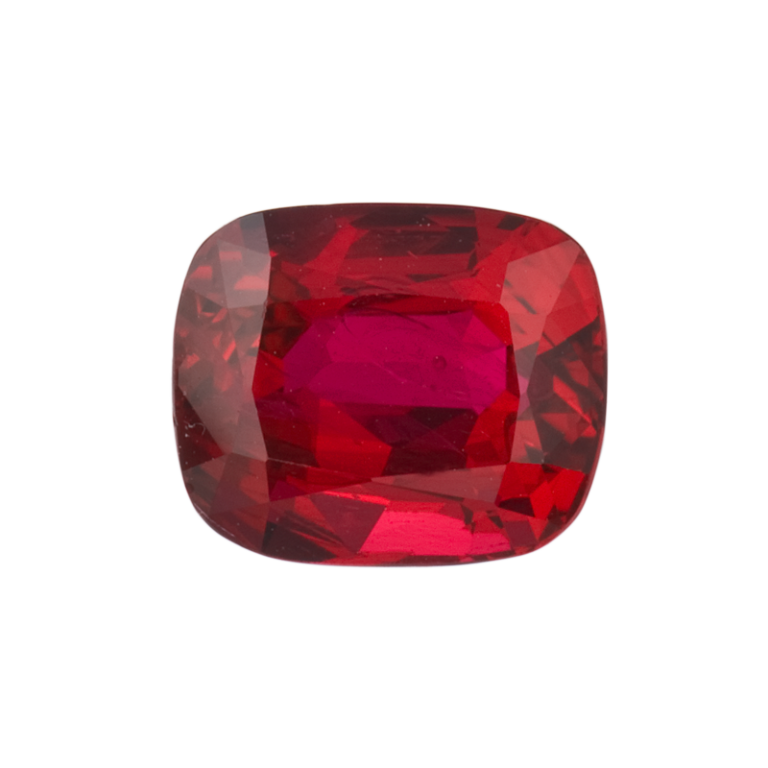
What is Ruby?
The ruby’s name is derived from the Latin term, ruber, for red. Like its sister gem, sapphire, ruby belongs to the corundum family of crystals, and its color comes from chromium oxide. The host rocks of ruby are metamorphic, like marble and gneiss. Ruby is separated through the washing of river gravel, sand and soil, then concentrated and picked out by hand.
Synthetic rubies have been created to be identical to natural rubies in chemical, physical and optical properties. Still, they can be recognized by their lack of natural inclusions and that they transmit shortwave ultraviolet light.
Which Regions Produce the Highest Quality Rubies?
Rubies are typically mined from the sediment in rivers and streams in Siberia, Thailand, India, Myanmar, Sri Lanka and Brazil.
History of the Ruby
Rubies were traded along China’s Silk Road as early as 200 B.C. In Burma—a significant ruby source since at least 600 AD—warriors believed that rubies made them invincible in some cases implanting rubies into their skin to grant protection in battle. Ancient Hindus referred to the ruby as the “King of Gems” and believed they’d be reborn as emperors if they offered rubies to the god Krishna. After the original Burmese mines were depleted, the Mong Hsu region of Myanmar started producing rubies in the 1990s. They lacked the vibrant red hue of traditional Burmese Rubies but were treated with heat to improve saturation and transparency.
Though the ruby has a long history, it wasn’t recognized as a variety of corundum until 1800. Before that, red spinel, tourmaline and garnet were also believed to be ruby. Even the Black Ruby, one of the famed crown jewels of England, was considered one of the largest cut rubies until determined to be spinel. One of the largest known rubies in the world is called the “Peace” ruby because it was found in 1919 shortly after World War I ended. The red fluorescence power of ruby helped build the first working laser in 1960.
What Are Rubies Used For?
Rubies—both natural and synthetic—are still used to make lasers, as well as watches and medical instruments.
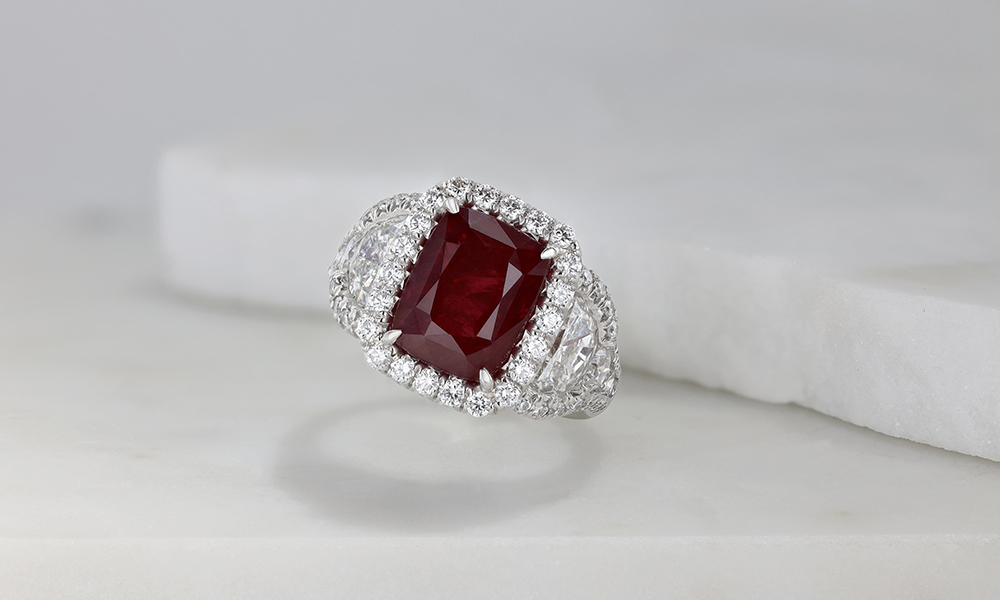
Ruby Color, Characteristics, and Value
A fiery statement piece, July’s birthstone is the perfect complement to the rising temperatures. Symbolic of passion and prosperity, rubies have been prized for centuries by jewelry buyers and makers alike. One of our favorite makers, Roberto Coin, even adds a small hidden ruby to the inside of their pieces to promote long life, health and happiness.
Ruby is the hardest mineral after diamond and can range in color from purplish-red to true red to orange-red. The most desirable color is pure red with a hint of blue. Garnet can be mistaken for ruby. However, garnet generally has a darker tone and is less refractive. Most rubies have been heat-treated to enhance their color at the time they were mined; this is a permanent treatment and does not require special care.
While rubies can be cut into almost any shape, large stones are rare. Inclusions are common with rubies and can indicate the geographical source of the gem. Rutile needles are a natural inclusion that creates a unique cat’s eye effect on a cabochon. When crystal inclusions are oriented in a specific pattern, a six-pointed star (called an asterism) becomes visible — making the gem a “Star Ruby.”
When considering the value of a ruby, color is the principal factor. Inclusions that cannot be seen with the naked eye also indicate higher quality. Rubies in sizes over two carats are rare. They can be more expensive than a diamond of comparable size.
Ruby Care & Cleaning
Ruby is a durable gemstone that can easily handle daily wear. Although there are no special precautions to take with this gemstone, keep in mind that all gems will scratch and abrade if they are not taken care of properly. Clean with a gentle solution made specifically for jewelry. Borsheims also offers small “ultrasonic” cleaners that clean your jewelry with high-frequency sound. It is crucial to have your jewelry professionally cleaned and checked three to four times a year. When not worn, ruby jewelry should be stored in a jewelry box lined with soft fabric.
FAQs
How Much Do Rubies Cost?
Ruby prices can vary quite a bit depending on the stone’s color, clarity, origin and size. You’ll find options starting in the hundreds, while rare, high-quality rubies can reach $10,000 per carat or more.
How Do I Determine the Quality and Worth of a Ruby?
A ruby’s value is determined by the 4Cs: color, clarity, cut and carat weight, with color carrying the most influence. The most desirable stones have a rich, even red color and minimal visible inclusions.
What Color Ruby Is the Most Valuable?
The most valuable rubies display a vivid, true red often described as “pigeon blood,” known for its balance of brightness and depth. Stones that are too dark or too pink are typically less valuable.
How To Tell If a Ruby Is Real
A real ruby typically has natural inclusions and strong color, while synthetic or imitation stones may appear overly perfect or glass-like. For complete confidence, a professional jeweler can confirm authenticity.
Are Lab-Grown Rubies Real?
Yes, lab-grown rubies are real rubies with the same chemical composition and structure as natural stones. The only difference is they’re created in a lab rather than formed in the earth.
What Are the Most Popular Styles of Ruby Engagement Rings?
Ruby engagement rings are often designed as timeless solitaires, surrounded by diamond halos, or styled in three-stone settings. Vintage-inspired looks are especially popular for their romantic, heirloom feel.
What Metals Complement Ruby Best?
Yellow gold brings out ruby’s warmth for a classic look, while white gold and platinum create contrast that makes the color stand out.
Are Rubies and Sapphires the Same?
Rubies and sapphires are both varieties of the mineral corundum, but rubies are defined by their red color while sapphires come in a range of other hues. Their durability is similar, making both excellent choices for fine jewelry.
Ruby is a popular gift option for those celebrating July birthdays and those commemorating their 40th wedding anniversary.